






The Networked Nonprofit Theatre: A Manifesto & A Book Review

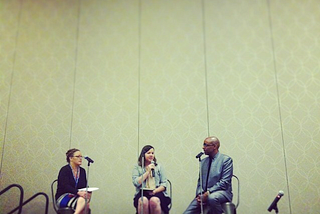
Last week I attended The Networked Nonprofit book launch in New York City, at this cool little joint called Demos. It was great to see Beth again, and finally meet Allison. I read about a book a week, so just a few hours after this event, I had torn through this one, dog earring most of the pages, scribbling notes in the margins, underlining like mad. In the mean time, I’ve been mulling over what I really thought about the contents, and probably more importantly how I could use it.

Then yesterday I woke up realizing I wanted to write both a manifesto, and a book review, all in one post! So here it goes.

The Networked Nonprofit isn’t a how to book. It doesn’t lay out a ten point plan for how to run your nonprofit, or even update your Facebook page. It doesn’t go into super detail about a particular case study. Because duh, that’s what the blog is for. Instead, The Networked Nonprofit asks a lot of questions, introduces you to a ton of awesome nonprofits each being networked in their own unique ways, and reminds you that social media has infiltrated every pore of our institutions. But I’m writing a manifesto here, not a book, so I’m going to break it down to my

10 Key Action Items.

  1. I declare these social media myths to be busted. Our audience is online, but we will strive to meet every one of them face-to-face. We will let social media’s influence seep into everything we do, but we won’t let it suck up all of our time.
  2. As a Millenial, I hold these truths to be self evident. “Millenials [are] passionate about causes, but not passionate, necessarily, about nonprofit organizations…[They will] jump from organization to organization as a particular effort moves them…[They are] a powerful new force for social change as free agents.” As such, we’ll stop cultivating Millenials and just focus on engaging them. We won’t bemoan failure when a Millenial only buys a ticket once, or only donates $10. Because every ticket and every dollar counts. And we know that the word of mouth Millenials are spreading are worth so much more than their filthy lucre.
  3. We have been endowed by Ward Cunningham with the incredible tools to work wikily. We will work in a hive structure (not a fortress!), engendering our culture with “real conversations intended to persuade people to behave or act in certain ways, not window dressing with an ulterior motive.” We will open our doors, and our website, and our board meetings, and our accounting books to the curious and enthusaistic public.
  4. Whenever any fear of social media becomes destructive of these ends, it is the right of the people (be they employee, employer, or constituent) to rebel. We will reveal unfinished plans and projects. We will make typos with abandon. We will graciously accept criticism. We will make staff of all level and manner available to the public. We will encourage employees to establish their own personal brands using social media. We refuse to be overwhelmed by the firehose of information.
  5. We assert the unalienable rights of The Intern. We understand that The Intern might be a high school student, an MBA, a retiree, or anyone in between. The Intern will be taken seriously, given real work to do, be respected for their opinion, and will be patiently taught the things they don’t yet know.
  6. In light of previous sufferances, repeated injuries and usurpations, we immediately establish Social Media Guidelines. Don’t be stoopid. What you say matters. We trust you.
  7. We therefore solemly publish and declare that our planning strategies will be a living roadmap to a sustainable future within our means, with clearly actionable items which our constituents should hold us accountable for.
  8. Our fortress ought to be totally dissolved, and that as free and independent people, our constiuents (hereafter named, The Crowd) have full power to levy their honest opinions of us, conclude that their collective wisdom is greater than our singular knowledge, contract with each other to create great art, establish a system of voting to select the best of our potential ideas, and to do anything else which helps us raise the necessary funds to do business. In short, we hereby conclude that a crowd of thousands can do innumerably more and better work than a paid staff of 10.
  9. In order to form a more perfect union, we will measure engagement and connections. We will look at trends in data, not just a snapshot in time. We will compare ourselves to others. We will measure things that matter to our mission. We will endeavor to map online engagement to offline actions.
  10. We hold it resolved that governance should be by the people, for the people. Not by a closed Board room, nor for the exclusive benefit of the staff. [nb: Ok, here's where you're just going to have to buy the book. The imagined example Beth & Allison used is just too good. It's page 154. It took my breath away.]

I’d work for that networked nonprofit. I’d go see their art. I’d give money to them. I’d sit on their board. I’d advocate for them in my community, IRL, and online. But there’s one quote I left out, that I just couldn’t figure out how or where to fit into the manifesto. Maybe it’s our tagline instead. People are not ATMs.

There was a lot more to the book, but I think this manifesto could use a little work. So here’s the scoop: I bought 2 copies of The Networked Nonprofit. Mine’s a mess, but copy #2 is pristine. I’d like to give it away to someone who was inspired by these ideas. So give me a shout out in the comments below. Put forth a new idea. Make an argument. Ask a question. Just say hello. Do whatever you want. On Friday July 16th I’ll randomly choose a commenter, and I’ll mail you my extra copy. If you ever run into Beth or Allison, they’d probably even sign it for you.

Possibly related posts:

  1. Stats, Observations, and a Winner from The Networked Nonprofit
  • http://internationalairportnews.com/2010/07/09/cheap-international-flight-tickets-online-via-book-my-trip/ Cheap International Flight Tickets Online Via Book My Trip | International Airport News

    [...] The Networked Nonprofit Theatre: A Manifesto & A Book Review | 24 … [...]

  • http://internationalairportnews.com/2010/07/09/book-travel-on-yathra-to-get-cheap-international-flight-ticket/ Book Travel On Yathra To Get Cheap International Flight Ticket | International Airport News

    [...] The Networked Nonprofit Theatre: A Manifesto & A Book Review | 24 … [...]

  • http://topsy.com/www.devonvsmith.com/2010/07/the-networked-nonprofit-theatre-a-manifesto-a-book-review/?utm_source=pingback&utm_campaign=L2 Tweets that mention The Networked Nonprofit Theatre: A Manifesto & A Book Review | 24 Usable Hours — Topsy.com

    [...] This post was mentioned on Twitter by Beth Kanter, Beth Kanter, Amy Wratchford, Amy Wratchford and others. Amy Wratchford said: My copy arrives tomorrow! RT @devonvsmith People are not ATMs: my manifesto & book review of @kanter & @afine's #netnon http://bit.ly/9YJv1a [...]

  • Beth Kanter

    I don't need another copy, but wanted to thank you for your review and kind words! It was great to meet you and I've been a huge fan of your work!

  • weihuang
  • http://createquity.com Ian David Moss

    Ha! Who could say no to that face? Anyway, great article, and I'll take the extra copy if you don't get anyone else besides Beth ;-)

  • Mary Anne

    Great Review – I have the book, but have not finished it yet because I keep re-reading sections! This is exactly what I need right now! Tons of great insights and ideas. You made me aware of the book at the AFTA conference – I was in your round table. Thanks so much and if I win the book I will see that it gets to another needy non-profit.

  • http://twitter.com/Nonprofit_Mo Maureen Carruthers

    With a manifesto like this one, I'm thinking the “mess” copy is probably the more valuable (although I see why you wouldn't want to give it away) Thanks for the kick in the pants. I don't have the book, but it looks like I need a copy.

  • http://twitter.com/WorkingLori Lori Hood Lawson

    Awesome manifesto! Thanks for sharing! (Now, if all nonprofits could put this into action…)

  • http://twitter.com/WorkingLori Lori Hood Lawson

    And, no, do not pick me for the book. I will happily go out and purchase! (And I agree with Maureen – the messy copy is probably more valuable.)

  • http://pervertedcoffee.wordpress.com Amy Murphy

    Hi! I've recently started reading your blog and want to thank you for it. I was so shocked to see how much thought has gone into NPO's using social media – it's a fascinating conversation that hasn't happened yet amongst the Irish theatrical community but I think it should – asap – as theatre here is failing miserably and it's not the lack of good companies or productions. I'm only the P.R.O. of my college's Drama Society at the moment but who's to say we couldn't start that conversation!

  • http://twitter.com/jamienyc42 JamieOB

    Landed here via a #2amt Twitter link and now apparently have hours more reading to follow. I appreciate the succinct statements about concentrating on engaging rather than cultivating and people re not ATMs. If you do select me for the second copy, I'd definitely appreciate going through the book. Two questions:
    1) Is there a group of some sort that I should be liking, following, etc to connect “live” with events like this book launch?
    2) Forwarding the conversation: Future-thinking ideas/letting go of going-extinct assumptions is all well and good in a debate, but what are some strategies for getting those who have been managing the efforts around those assumptions to let go of what they know how to do? I actually work in an environment that is very supportive of trying new things where old ones aren't paying off, but there's still one or two holdouts who often either kill an idea or let it happen but make the process 100x harder.

  • Guest

    Less arrogance, more substance. It's about the art, not about “us”. Whoever “we” are.

  • Jadison

    Someone once said: “The biggest problem with opera is opera people.”

    I have to wonder if the same doesn't apply to theatre. I'm pretty sure it does.

  • devonvsmith

    I get that. It's absolutely about the art. Interestingly, TNN seems to take quality of the work you're doing as a given, and instead focuses on what the organization can do to run more efficiently & effectively by including more stakeholders into the process of making decisions. Hopefully, organizations that gave a greater voice to artists within the institution (as well as many other stakeholders), would find that more decisions were being made with the art in mind.

    The “we” is all imagined. I just lifted a bunch of language from the Declaration of Independence, which is why it probably sounds a bit more arrogant than intended.

  • devonvsmith

    Hi Jamie,

    welcome!
    1) Sounds like you've already caught on to the #2amt feed of 'info you should know.' Following @kanter also certainly helps. For #netnon specifically, there's a website that lists upcoming events (http://www.networkednonprofit.org/). You could check out your local chapter of MeetUp, sometimes I find great events through there.
    2) Actually, I just read an awesome book called Switch: How to Change Things When Change is Hard (http://www.amazon.com/Switch-Change-Things-When...). It gave a lot of great strategies for how to make hard changes within an organization. Definitely recommended!

  • http://twitter.com/Stephen_P_Brown Stephen P Brown

    Grt idea to get comments! Love it.
    Here's a prob: bountiful ideas for changing people lives via the arts. As Tom Peters suggests, such ideas should be excellent, but sharing an excellent idea isn't easy because perfectionism gets in the way. So, how does one person share their incomplete ideas, engage helpers, and after an event, get paid through it's execution?

  • http://twitter.com/Stephen_P_Brown Stephen P Brown

    and orchestral music

  • devonvsmith

    Thanks Lori!
    I sometimes wonder if *all* nonprofits could or even should put something like this into action. I think what I saw that was interesting in the #netnon book was that everyone needs to figure out what works best for them, and it may not be to stuff all of these into 1 organization. Or it might be. At least, it was for my imagined/idealized theatre :)
    Proposition: Can I keep you in the pool of possible winners if you promise to go buy & give away your own 2nd copy if you win? Paying it forward and all…

  • devonvsmith

    That's awesome Mary Anne! Glad I was able to turn you on to #netnon. Good luck getting to the final chapter (and then the even harder part, actually implementing!)

  • devonvsmith

    shhhh. Also not giving away “my” copy because Beth signed it! :)

  • devonvsmith

    :) Who *could* say no to that face? Thanks!

  • devonvsmith

    As always, thanks! Also, thanks for being the commenter guinea pig :)

  • devonvsmith

    Hi Amy!
    Ireland?! Amazing. I'd love to hear more. I know not nearly enough about what's going on with the management of theatre outside the US. You should absolutely start that conversation. I'm sure there's more folks like yourself around…

  • devonvsmith

    the 'comment for chance to win a free book' idea is lifted directly from Beth's blog actually :)

    If you're asking about motivation for why someone shares their ideas, I think Clay Shirky's Here Comes Everybody is great. But if it's more about how to get over that perfectionism (or encourage others to), I think it's all about taking small steps, and seeing that the whole world will not fall apart (nor will your organization) if you share those incomplete ideas. As for getting paid post execution–no idea! If you figure it out though, lemme know

  • Tom Schoessler

    Dear Devon, thanks for this post.
    If I may, I would like to take some time and comment on your manifesto's item #5, which to me is a tremendously important issue. And picking up your comment about hardly hearing about developments outside the US, I feel encouraged to provide some background from Germany. Last year the German Cultural Policy Institute http://www.kupoge.de released a manifesto called “Fair Internship”, which states guidelines on how arts institutions should treat their interns, since the sad truth in Germany seems to be that they're often just cheap labor in a desired arts business. And often times they just do, well, stupid work. For the non-profit theater I work for, actually the largest so called “Socio cultural center” in Europe (http://www.theaterhaus.com), we have adapted this manifesto (and blogged about it http://www.theaterhausblog.com/2010/04/theaterh...).
    But since you probably don't speak German, here is the essence of it. Maybe it can be a suggestion to institutions in other countries. They seem to be just a few obvious points, but I guess not even those are being lived up to by most arts institutions.

    “An internship is for education. An internship is for learning. An internship helps us. In other words: an interns efforts are met by counseling, demanding tasks, and financial appreciation.

    With this Statement, Theaterhaus Stuttgart commits to the guidelines of the “Fair Internship”.
    - Interns in our institution always have a personal counselor or a person they can ask.
    - At the beginning of the internship, the “learning goals” are established in written, which is done together with the intern in order to include their needs and knowledge. The learning progress is tracked continuously and summed up in a detailed letter of reference at the end of the internship. An intern should receive this letter shortly after their last working day.
    - All internships comply with the intern's level of qualification.
    - In their first days with us, all interns get a profound introduction, and a training plan which enables them to acquire all skills necessary for a successful learning and working experience.
    - An internship of more than three months is a benefit for the intern, but also for us. Such interns will hence receive a monthly compensation according to their level of education, and be granted equal vacation days as any other employee.
    - We do not distinguish between a voluntary internship and one demanded by the intern's education institution. We value effort, not universities' requirements.
    - There are no internships with a finished degee. Fully educated, they should not be used as cheap labor.

    Interns have always been equal members of our staff. With our commitment to the “Fair Internship” we state that their guidelines will be applied consequently, even though it is a challenge to our personal and financial ressources. In times of decreasing public funding support, we see this as an important sign to fair employment in all age groups.”

    Btw: Sadly, we are still the only actual theater to have signed the guidelines.

    Thanks for taking the time to read this. And if you like to comment back, I'd be interested in the intern practices in the US. How long do interns usually stay? Do they get pay in the arts field there?

    Thanks and all the best.
    Tom
    Theaterhaus Stuttgart, Stuttgart, Germany

  • Eleanor

    awesome manifesto. That part about respecting the intern is getting forwarded on to some people I know : )

    And I wouldn't mind a new book to read!

  • devonvsmith

    Awesome. Good luck in the random drawing then :)

  • devonvsmith

    hey Tom,

    Thanks for all the great info! Congrats to your theatre for signing the guidelines–they're quite noble. There was actually a big brooha when the NY Times came out with this article on the “legality” of internships a few months ago: http://www.nytimes.com/2010/04/03/business/03in.... It gives a pretty good description of what the actual rules are, though you like you've pointed out, very few institutions actually follow them. Of course, as a manager myself, I know how much time it can take to train a new intern, and how much of your time & resources it can consume to have an extra person in the office. But as someone whose had 7 internships in the past 10 years, I can say that there's WIDE variability in how companies treat interns. That said, most theatre interns stay for 2-3 months (usually full time summers/part time school year), and can get paid anywhere from just a handful of free tickets to local performances, to somewhere around $500 a week.

    Hope this was helpful!

  • http://pervertedcoffee.wordpress.com Amy Murphy

    I sure hope so! I can see it doing wonders for the theatre scene over here.

    I'm probably not the most qualified to give you a primer on Irish Theatre Management but I'll certainly do my best. For the most part Dublin – our capital city – has a pretty good structure. There's good training, good support and just enough interest to keep a few professional companies going. They tend to follow the models put forth by the British system which shouldn't diverge too much from what goes on in the U.S. Maybe funding structures differ.

    Outside of Dublin it's a disaster. As far as I'm aware there are very few professional groups – not because of lack of interested creators but a serious lack of an interested audience. In fact, Cork's (the second city) Oprah House has now been temporarily shut for three months due to lack of support. Also, the country holds a good few festivals where there is some wonderful theatre shown but apart from those one or two weeks the theatre scene practically dies. I also find it atrocious our “National” theatre never travels outside of Dublin!

    I attended a symposium as part of one of these festivals, the main theme was “Has culture failed Ireland?”. Listening to some of the most important leaders in the Irish Theatre sphere I can confidently identify the answer as yes – because we've completely ignored audience development and efficiently marketing ourselves to the Irish public. All they could talk about was funding issues and management issues, which really they don't have a problem with and that tickets aren't selling because the audiences are 'ignorant' but they failed to discuss properly engaging that audience! It's a terrible shame. I don't know if that's what you wanted to know – but feel free to ask me anything!

  • http://thisisanawesomewebsite.com/2010/07/a-few-reviews-of-the-networked-nonprofit/ A Few Reviews of The Networked Nonprofit | This Is An Awesome Web Site

    [...] hosted by Demos  last month.  Devon was inspired to write a book review as well as a ten-point Networked Theatre Manifesto.  I like point 5 about interns. We assert the unalienable rights of The Intern. We understand that [...]

  • http://thisisanawesomewebsite.com/2010/07/a-few-reviews-of-the-networked-nonprofit/ A Few Reviews of The Networked Nonprofit | This Is An Awesome Web Site

    [...] hosted by Demos  last month.  Devon was inspired to write a book review as well as a ten-point Networked Theatre Manifesto.  I like point 5 about interns. We assert the unalienable rights of The Intern. We understand that [...]

  • http://broadwaymusicalhome.com BroadwayMusical

    I don't know how on earth I've not run across you before, but you are amazing. Keep up the wonderful work and thoughtful commentary. I agree with this manifesto wholeheartedly. The world is changing as Millenials assert themselves and realize they don't need to work their way up the ladder or pay their dues or be the useless intern…we believe we can change the world and we are not going to stand and watch others do it for us.

  • http://twitter.com/jamienyc42 JamieOB

    Thanks!

  • Guy Granger

    Idea: we will give a voice to the previously voiceless by opening our social media channels to sub-channels, guest messengers, and views from the inside.

  • http://www.devonvsmith.com Devon Smith

    Glad you found me!

  • http://www.devonvsmith.com Devon Smith

    That’s awesome. I love the “sub-channels.” Thanks!

  • Hamada Mclaughlin

    You and your blog rock. :)

  • http://www.hoongyee.com Hoong Yee

    My my my quel manifesto!

    Nothing like holding something great, taking aim at a higher goal and kicking it straight through the goal posts – and then passing the ball. I have thought a lot about what my own take aways from this timely book would be and have brain tsunamied a twelve step plan for the network nervous. still a work in progress, still room to be rewrite and reinvent, still space to be inspired by your fierce and fabulous manifesto.
    You truly embrace the Tolstoy quote that opens Part One about changing the world, changing yourself. I am confident that the transparency and transfer of cached assets to collective capital will indeed change the world, one bold manifesto waving leader at a time. Bravo! http://www.hoongyee.com

  • coryhuff

    Devon, I might quibble with point #8. You know that I'm all about social media & things like crowd sourcing, but I don't think that a crowd of thousands can always do better work than a paid staff of 10. I think it's more like a crowd of thousands (of the right people) can do better work with the guidance of a paid staff of 10.

    In any organization or movement there are the people who are really knowledgeable and good at leading. You need those people. Otherwise its anarchy.

    That said, I still agree with you that Arts orgs need to open up more – not “it's a good idea” – they NEED to do it, or they're going to go away.

    Oh, and I'd love to see more web-only content from theatre companies. Needs to happen.

  • http://twitter.com/RedHookArts Martha Bowers

    Totally agree about your bones w/ #8, but web-only theater? No thanks! (I think that's called “Film”) @redhookarts

  • http://twitter.com/RedHookArts Martha Bowers

    Hey Devon-

    Fascinating stuff to think about, so much we haven't had time for at a small community arts org. in Red Hook, BK (but absolutely need to MAKE time for).

    The biggest question I'm left with- this stuff seems great once you're at a certain threshold- say 500-1k followers, say.
    Is social media useful for building up to that level, though, or does it really have to be more old-fashioned cultivation to get to a certain level-functioning community?

  • devonvsmith

    That's such a great question Martha. Mathematically, it's certainly true that those theatres with a larger following base tend to be able to reach further degrees of separation from their fan base with every ReTweet or Facebook comment. But smaller theatres, with a smaller follower count, have the opportunity to have a more personal relationship with their fans/followers.

    I've seen some research for example on blogs specifically–when you have very few people reading, the blogger gets to know each of those commenters personally and can respond very quickly; then when readership grows past a certain point it becomes impossible to know & respond to everyone, so the “community” aspect dissolves, until readership makes another leap forward and it's suddenly seen as prestigious to be commenting on such an influential blog so you see the ratio of commenters:readers jump quite significantly. In other words, it's a U-shaped curve, rather than a linear relationship of more readers = more comments. I would hazard a guess that it's similar with the other social media platforms.

    But in order to build that community in the fist place, I think you've got to have great content and that “old fashioned cultivation” that you're talking about.

  • devonvsmith

    Definitely true. It takes a whole lot of staff resources to successfully corral a crowd of thousands, and there needs to be the right fit between decision/action and the person or people making the decision/action.

    I'm curious what kind of web-only content you're talking about. Creative content? Supporting a live production, or as the main event itself?

  • devonvsmith

    Thanks! Good luck with your brain tsunami. What an awesome phrase.

  • devonvsmith

    That's great Guy! Let's not only give a voice to the voiceless, but also give them a megaphone & a platform to be heard.

  • http://www.devonvsmith.com/2010/07/stats-observations-and-a-winner-from-the-networked-nonprofit/ Stats, Observations, and a Winner from The Networked Nonprofit | 24 Usable Hours

    [...] staffing strategy TCG Twitter Vocalo web design Yale Rep Yale SOM Yelp youtube Most PopularThe Networked Nonprofit Theatre: A Manifesto & A Book Review (46)A Rant Against Facebook (10)Foursquare's (Lack of ?) Growth (9)A Proposal for TCG (8)A Digital Media [...]

  • coryhuff

    Absolutely creative content – as well as 'human interest' and other content. Have you seen Second City's Sassy Gay Friend stuff? http://www.youtube.com/watch?v=LKttq6EUqbE

    It started as a one-off piece, but became so popular that they made it a series.

    Most popular TV shows and films have web-only content that supplements their main content – it builds buzz and anticipation.

  • Peter

    Devon,

    Wonderful article, and the manifesto makes me think SO much about all that seems possible with optimized networking. I'll look for a copy of this book.

    In the meantime, to one of your commenters, um, comments regarding how small scale organizations with no staff to speak of might prioritize the networking options in order to try and gain the most benefit from (all of these) platforms for networking, while balancing this work with all of the other things on one's to-do list?

    And one final, random question, what do you know about the news item from many years ago, when Radiohead made their (at the time) new album available FREE to the public to download? Can you imagine this working in a performance setting, where no tickets are sold, and somehow it still generates income? I suppose it'd help to be Radiohead before one attempted this, but it does make me wonder… Thoughts?

  • devonvsmith

    Saw this today, and thought of your post: http://www.boingboing.net/2010/07/20/social-med.... I thought the last paragraph was especially intriguing, “When you think about it, social media makes all of us into playwrights, turning ourselves into characters and our lives into scripts. We upload pictures that make us look way better than in real life, we labor over getting the phrasing of an update just right. And so it seems oddly fitting, as we move through social media spaces, to run into fully fabricated characters, whose creators have unleashed them onto a different kind of stage.”

  • devonvsmith

    Hi PK!

    Prioritizing your social media presence, if you're say, a dance company with a single employee? I'd say:
    1. Focus on your website first, making sure it's easy for users to learn about upcoming productions, buy tickets, and give money. All the Facebook fans in the world won't matter if they can't figure out how or when to buy tix/donate.
    2. Then I'd start a fan page on Facebook. You have a great community of dancers, friends, and colleagues who attend every one of your shows (like me!)–you can use a Facebook page to let us all know what's going on with you on a more regular basis, share photos from recent shows/classes, etc. You also spend so much time traveling, it's a great way to connect with people all over the world. You can think of your FB page as part newsletter/part historical archive of all you do/part celebratory cocktail party where all the folks who like your work get together to discuss. It'll also be easier to host FB events (like workshops, classes, etc).
    3. I'd consider putting the tiny dance series on vimeo, and cross posting the videos on Facebook. I think these are such awesome examples of the work you do, but as is, they're hard to find online. Vimeo's interface matches the aesthetics of the series better than youtube, and tends to lend it a more 'artistic' feel.
    4. I'd wait to start a twitter account, or a blog, or anything more complicated until you feel more comfortable managing a Facebook page.

    In terms of pricing, from what I remember average download price of In Rainbows during the PWYW period was about $4, but was actually split–most downloaders paid nothing, a few dedicated fans paid way over market price, so it all evened out in the end. That would imply, you need those “super fans” to subsidize the masses–much like actually individual donors currently function in relation to the average ticket buyer for a theatre/dancer. While the download price was less than half of the average price for a CD, Radiohead got more money from the “free” version than for their previously sold CD. Important to remember also, this only lasted for 3 months, and then they took down the offer, and started selling the physical copy for a set price in stores (and offered $80 box sets also, again for those 'super fans').

    We actually spend a great deal of time talking about pricing on Twitter (search for #2amt, or check out the blog at http://www.2amtheatre.com). You can find a great 3 part series on pricing at http://www.2amtheatre.com/?s=lucre.

    hope this helps!

  • Peter Kyle

    Thanks for your reply, Devon! So clear and doable, it seems. I'll look up the discussion re: pricing, too. So interesting to consider the implications of why certain things work for certain “brands” and perhaps not so much for others…

    Great food for thought! You're the best.

  • http://devonvsmith.blogger.com Devonvsmith

    Devonvsmith…

    [...] something about devonvsmith[...]…

blog comments powered by Disqus